Sunday, October 20, 2013

Mt. Ontake

Today was our day to hike Mt. Ontake, the second highest volcano in Japan, one of the hundred famous mountains of Japan, and a sacred mountain that draws Shinto pilgrims to climb the path to the top. Not so much today, though, as it was pouring rain. 


One of the many shrines along the hiking path. 

The bus ride from Kiso-Fukushima to the trailhead took an hour. Gorgeous mist-shrouded scenery, looking like a wood-block print. We even saw more monkeys along the road! Roxana says these monkeys are famous for soaking in the hot springs when the ground is covered in snow. 

By good chance, we had made a quick stop at an enticing bakery on our walk to the bus this morning, and look at the pastry Dave choose because it had a chocolate filling:

We hiked for an hour, but the rain became even more intense, & we decided to turn around and take the 12:45 bus back to Kiso-Fukushima and a soak in the bath. 

Temperature at bottom of trail.


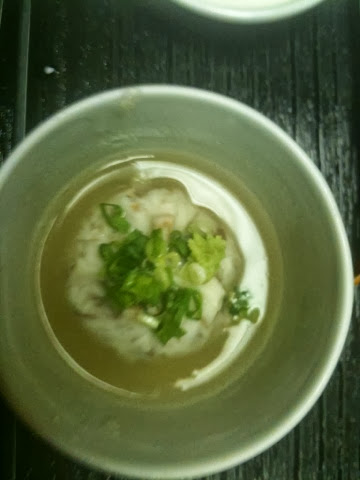
We had a bit of time to wait for the bus, and discovered a bare-bones cafe in a building near the bus stop. But it had heat, and absolutely the best ramen I have ever had! 

Not that we have been eating poorly; our inn is renowned for its food. Here's pics of tonight's dinner. There are multiple pics because there are multiple courses. We are served in a private tatami-floored dining room. 

1st course place-setting. The presentation is beautiful. That's sashimi in upper right, with a dipping sauce; a hollowed out persimmon with a compote in the hollow, at the top; and several elegant tidbits surrounding 2 pieces of pork on the bottom plate.

Sukiyaki was also part of first course.

Also in first course. Various pressed fish cakes in a warm broth.

2nd course (you remove the leaf wrapping to eat the baked fish inside).

3rd course. Lotus root in a seaweed base. Note the little basket in which it is served - presentation is everything!

4th course. A dumpling. 

I missed a photo of the 5th course, a clear broth with a shellfish that could have been a scallop - being allergic to scallops, I passed. That's also the course where the rice was served - Roxana says that in gourmet Japanese meals, the rice is always part of the last course (before dessert). 

6th course - dessert. Those are melon balls with a sweet bean paste and a custardy base in a sweet syrup. 

So you can see we are definitely not going hungry - and the breakfasts are almost as hearty!

We leave this inn tomorrow for more walking on the Nakasendo to Tsumango, which Roxana says is even more beautiful than Narai - hard to believe. 

Saturday, October 19, 2013

The Ritual of the Bath

The Japanese have pretty much nailed the bath. A wonderful experience at any time, it's nirvana after a day of hiking. 

When you arrive at your inn, a basket is ready for you in your room. Inside are a bath towel, a robe (yukata), a sash, a washcloth ( and a toothbrush - not for the bath, per se, but interesting because you really could travel to Japan & not bring a toothbrush). Because it is Fall, the basket also includes an over-robe to use if you get cold (Karen - that is what that brown silk robe that Dad had is. So interesting to see all kinds of things that Dad brought back from Japan and have an 'aha' moment). The over-robe also has a pocket; the yakuda does not. If you are a couple, you still get one basket, but every item is doubled. 


Our 'deconstructed' basket at the Narai inn. Yukatas and sashes still in basket, towels, and washcloth/toothbrush bags below basket. To the right is the open tea set box. A tea set is also normally provided in each inn room, along with a thermos of hot water. A canister of green tea is included in the tea set box. 

In my yukata at Kiso-Fukushima Inn. (No, not THAT Fukushima). 

There will be two baths - one for the men, and one for the women. I think the general convention is the door hangings are blue for men & red for women ( I'm still haunted by my Hungarian spa experience, where I entered the men's changing room by mistake). 

Once inside, you'll find a changing room.

Each cubicle has a basket to put your  belongings in. Disrobe, and it's time for the next step; a full cleansing before entering the bath.

In this bath you can see five cleansing stations, each with its own stool. On top of each stool is a round wooden bowl. Pull down a stool and place it in front of a spigot. The bowl can be used to pour water over your body, or use the shower hose. Soap and shampoo are provided. Make sure to rinse thoroughly before entering the communal bath - it is a HUGE faux pas to sully the bath.  


Then get ready for heaven - a long soak in the tub. In this case, you can also see an outdoor tub. 

On the Nakasendo


You know it's been an exciting day when you get to talk about the wildlife on the trail and it includes monkeys!
While I admit he's difficult to see, that's a monkey sitting on a tree branch near the top of the photo, to the right of the large tree trunk. There were loads of monkeys here, in the trees & scampering across the trail, but always too fast to get a good shot. 

But I get ahead of myself. Here's how we started our day at the minshuku (family inn, somewhat analogous to a B & B) in the preserved old post town of  Narai, where we spent the night:
That's a breakfast place setting for one. 

Most of you probably need a quick primer on the Nakasendo:
The Nakasendo was a highway that ran from Kyoto over an inland route before ending at Tokyo’s predecessor, Edo. Established in the 8th century it reached its zenith in the Edo period – a bustling highway for nobles, samurai, merchants, and commoners alike. In the past it would take travellers 18 to 20 days to walk the full length of the 533 km (330 mile) road, and there were 67 stages along the way. The introduction of the railway revolutionized Japan at the end of the 19th century and the old-style highways fell into disrepair.
Much of the original Nakasendo Highway is now gone, but there are still some sections of the old road that, along with connecting stage posts, have been preserved. (Source: http://www.nic-nagoya.or.jp/en/e/archives/648) 

Our friend, Roxana Lewis, a fellow Sierra Club & Highpointer member who is also a travel agent, told us about this trip 2 years ago. It sounded fascinating, and we said 'sign us up'. And here we are!

As the description states, the entire Nakasendo road no longer exists - although we did meet a woman on the trail today who had walked the entire trail, from Tokyo to Kyoto, 17 years ago. That would include a lot of walking on modern roads, however, which were built over the old Nakasendo. And today was a good example of that. We left our inn and walked to the edge of town, where we continued on a preserved part of the Nakasendo, up a forested path to a pass (where we encountered the monkeys). The afternoon hiking, however, was along a modern road. Still interesting - it reminded me a lot of hiking in Great Briton, where you come to small villages every few miles. 

I took lots of photos today, and they will give you a better feel for the hike:

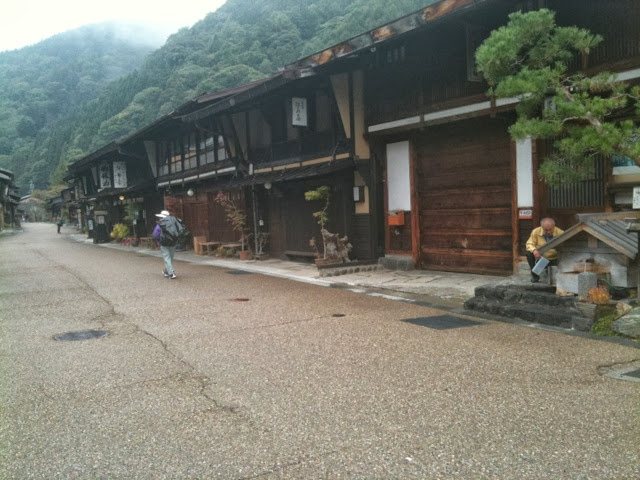
Starting out - the preserved post town of Narai. 

Dave placing a coin in shrine along the way. 

Torii Pass. You ring the bell to warn off the bears. Didn't see any - can't say if the bell was the reason. 

Persimmons for sale in the next post town. 

Scenery along the modern road. I love the rural scene with the high-speed train rushing by in the background. 

Many of the road signs include English. 

Although sometimes the spelling is a bit strange. (Wait for it...)

Tomoefaguchi Beautyspot. That's what the sign said in English (after about a paragraph of Japanese characters). It was beautiful - there is a spring falling down the rock wall you see. 

Persimmons drying outside a small village on our route. 

In the old part of Kiso-Fukushima, just a few steps from our inn. 

Friday, October 18, 2013

Narai, or Eat Your Heart Out, HJS


Cathy, Dave, and Roxana at the entrance to our inn in Narai. Note the wooden architecture. It is one of many buildings in this town which have been declared a Cultural Asset by the Japanese government, as these buildings have been kept very much the same as when they were built in the Edo period. 

Dave getting dressed in our traditional tatami room in robe provided by the inn. Note futons behind Dave. 


Our gourmet dinner.


At dinner. Upon being told by me that he could be my samurai, his response was an eager  'Do I get a sword?'

Tomorrow we begin hiking the Nakasendo with an 11 mile and 2000 foot of gain day to the next post town. [post-trip update: the gain was much less; Dave made a calculation error when converting from meters to feet].

Kappy's apt comment:
Of course Dave would want a sword..... to slay dragons...... or maybe you'll come across Godzilla. 

Thursday, October 17, 2013

Tokyo

We started our day with a buffet on the 25th floor of our hotel. Here's a photo I took out the window:

There had been a typhoon warning the day before, but our weather was fine. 

First stop was at the train station to pick up our Japan Rail passes. Here's Dave walking through the Shinjuku station with his Maine HighPointers t-shirt:

Wish I had taken a picture of the 20ish couple ahead of us in line; she was decked out in a full red& white patterned skirt, with many petticoats and a straw boater (hat) adorned with fake strawberries. I thought they were from Bavaria (ok, an alternate universe Bavaria)  and was surprised when Roxana asked them where they were from, and the reply was 'Alabama'. Roxana then asked the woman where she had obtained her costume, as if it was the most natural thing in the world. This was my introduction to 'Harajuku Girls'. It's a form of dress, with devotees, as with manga, who come from around the world to experience where it all began.  (The answer, BTW, was 'online').

Next stop was Nakamise-dori, a street in the present day Akakusa area of Tokyo, which served as "downtown" Tokyo in 1600 -1800. It's an example of a shopping street in old Tokyo. Kinda like Olvera St in LA. Note the decorative red maple leaves above the stalls. Every season would have a different display - cherry blossoms in Spring, for example. 

Nakamise-dori  ended at a Buddhist temple. The Japanese tend to honor Shinto rites for weddings, and Buddhist rites for funerals and honoring ancestors. I lit a candle for Dad in the temple. 

Roxana chatting up Buddhist monks from Sri Lanka she met on our way to the temple you can see ahead. 

Tsukiji fish market was our next destination. You can't go wrong finding a good sushi restaurant next to the Tokyo fish market. We four shared a combo platter, were totally sated, and the entire meal came out to $5 per person. With a knowledgeable guide like Roxana, Tokyo does not need to be expensive!

Then it was on to stroll the Imperial Palace Gardens. Dave was ready for a nap after this, and Cathy kindly offered to go back to the hotel with him so Roxana could walk me to the Imperial Hotel for my Frank Lloyd Wright fix. Did I mention that both Cathy and Roxana speak Japanese? Thank goodness!

Autumn floral display on Tokyo street. 

In front of one of the carvings saved when the FLW designed Imperial Hotel was torn down in the '60's. There was also a special exhibit commemorating the FLW designed Imperial hotel in the lobby. 

On the way back to out hotel, we were able to walk through the Ginza, so I can now say I've been. 

After a long & satisfying day of touring & walking, and still battling jet-lag, we all turned in early. 

Wednesday, October 16, 2013

In the Land of Toto

My first experience with the wealth of Japanese toilet options occurred at the Tokyo airport. I was happy to see a women's restroom fairly soon after we exited the plane, but a bit confounded when the first stall I came to contained only a porcelain bowl in the floor. Then I noticed that every stall had a pictogram outside that indicated what type of toilet it contained. In addition to the floor bowl, there were sit-down toilets, toilets with spray options (more on this in a minute), stalls with changing tables, and stalls with a shelf seat where a mother could put a child. And, of course, all were Toto.  Wow!

When we got to our hotel, we had a Toto Washlet toilet. Here's a picture of the controls, and also the instructions attached to the bathroom wall:


And, yes, I tried them all!  

Oct 18 Addendum:
Had to add today's new Toto experience: a heated toilet seat at the inn where we are staying the night!!  True luxury. 

Oct 20 Addendum:
On the trail today, Cathy told me she has heard there are Toto toilets that have a fan to dry you. Think of the toilet paper savings! 

Oct 22 Addendum:
Ask and you shall receive! Our minshuku in Tsumago had the air dry feature. It was a pretty spiffy toilet - you flushed using a control pad mounted on the wall, conveniently located just above the toilet paper, a first for me. 


My travel companions get a laugh from my obsession to photograph Japanese toilets. Even so, I notice our dinner conversations often include new toilet features we have discovered that day!

Tuesday, October 15, 2013

Even the Club Lounge Isn't Immune to 'mechanical delays'

Departure delayed 3 times; now being told there has been a plane change. I'm getting evil stares from others in lounge because I was here early enough to snag a  desk & I am not giving it up.

At least they have changed out the continental breakfast for crackers, cheese, pretzels, Milano cookie packs, and chocolate covered raisins. 

Checked my backpack; here is my carry-on. Left the mug and pen on the left for scale. You can see it's pretty small. Aside from a toothbrush, extra contact lenses, and my iPhone earbuds and charger cable, most of bulk is newspaper I brought to read - and do the KenKen! 
My passport and boarding pass are in case that hangs from my neck, both for security and ease of access when walking through the check-in process. 

Pack in picture below was a favor from the AZ HighPointers convention. Did not think it would be very useful, but it has turned out to be a handy travel accessory. I keep it in my suitcase because it packs flat, is very light, yet becomes a useful backpack for walking around and keeping your hands free. So it was the perfect choice for a trip where my only other bag is a full-size backpack - not a FULL backpack, just full-size.  I weighed it last night at 16 pounds without water. Trying to travel light. 2 pair pants, 1 pair fleece pants ( we hike one day to 10,000 feet), 3 tops (1 is wicking base layer) fleece jacket, rain shell, underwear, 2 pair wool socks, 2 pair liner socks, 1 pair hiking boots, and 1 pair Teva sandals (can wear these with socks, if necessary). No need for bathing suit in the onsens (japanese baths) we will visit on the trail, and Roxana assures us every ryokan (traditional inn) will provide a cotton robe we can use to sleep in, so no nightclothes, either. Probably will be doing some bathtub clothes washing, but so be it. Better than feeling held back by extra luggage.

Supposedly should board any time now. Next post from Tokyo.